





Zwiększenie oszczędności i redukcja pracochłonności w obszarze normaliów.
Branża: kolejowa
Cel projektu: usprawnienie procesów i oszczędności
Obszary: logistyka, zakupy, finanse, produkcja, B+R
Duration: dwa tygodnie
Liczba osób w projekcie: 5

Estimated results of the project
1 milion złotych redukcji wartości magazynu 168 godzin mniej miesięcznie na administrację 3 milionów złotych oszczędności TCO
Why are standard parts a challenge and not a source of savings for manufacturing companies?
As part of the initiative Why Shopping? As part of the Why Purchasing? initiative, we spoke with Paweł Kudzia from Woodward company. He emphasized the challenges of generating savings faced by companies that have an extensive supply chain. Many suppliers provide components that are ultimately assembled in production. He described his supply chain as "low volume - high mix". You can watch the entire recording in the accompanying video.
How does this relate to our case study?
We often encounter the situation described by Paweł among our clients. Companies that are OEMs or are positioned high in the value chain are often characterized by the immortal Pareto principle:
20% of the purchased expensive components account for 80% of the material costs and savings
However, what strikes us the most is another proportion:
80% of the process costs and troubles are generated by components with relatively low prices but complex logistics and supplied by a large number of suppliers. In other words, the remaining 80% from Pareto.
The Pareto principle doesn't work in tail spent management. Solutions are needed that fundamentally change the way we operate to document attractive savings. Today, modern Industry 4.0 technology comes to our aid. It allows us to network devices distributed throughout the production facility with the supplier system.
We had to face precisely such a situation with a client in the railway industry (nowadays often referred to as Mobility).
What do market trends say?
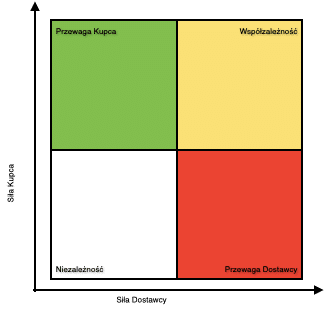
Zgodnie z najnowszymi trendami zakupowymi komponenty c-klasy są klasyfikowane jako „outsourcing ze względu na zdolności”, szczególnie w sytuacji low volume-high mix, zgodnie z macierzą bilansu sił. Przyjmuje się, że dla tego typu komponentów, firma chcąca skupić się na swojej działalności głównej, powinna rozważyć i wdrożyć rozwiązania typu lean. Rozwiązania te oparte są o usługę, której kluczowymi wskaźnikami efektywności są: dostępność, elastyczność, autonomia, oszczędności. Wsparcie oferowane przez dostawcę ma zapewnić klientowi elastyczną realizację działalności głównej. Obecne i przyszłe trendy dotyczące zarządzania c-klasą wskazują na odchodzenie od zakupu komponentów w kierunku zakupu serwisu związanego z dostępnością komponentów po optymalnym koszcie.
Szczegóły case study w firmie z branży kolejowej/mobility
Księgowość i controlling
Zidentyfikowane wyzwania:
- Manual and time-consuming invoice processing
- Nearly 15,000 invoices per month
- 13,000 invoices represent the actual capacity of a 7-person department
- An average of 2,100 invoices per person per month (100 invoices per day!)100 invoices a day!)
- Overtime and backlogs up to one week in invoice entry reaching one week in the entry of invoices
- Late payments to suppliers result in a backlog of firefighting in purchasing, controlling, and accounting departments firefighting in purchasing, controlling and accounting
Zaproponowane rozwiązania:
- Standardizing invoicing terms in monthly cycles on a monthly basis
- rapid uplift Rapidly increasing the percentage of electronic invoices from 12% to 80%
- Enforcing the requirement for suppliers to include order numbers and customer index numbers on invoices indication of the order number on invoices and customer index numbers
- Improving the electronic document workflow for resolving discrepancies electronic workflow in clarifying inconsistencies
- Introducing the "noPO, no Pay" indicator to increase purchasing transparency „noPO,no Pay” in order to make purchasing more transparent
Production
Zidentyfikowane wyzwania:
- Production documentation is not always updated in a timely manner compared to the actual execution of a particular component. Planners order components that are not needed and fail to order the necessary ones vs. the actual execution of a component. Planners are ordering components that are not needed and not ordering components that are needed
- Some assembly sockets contain a large number of excess and unused components a lot of elements that are in excess and not used
- Team leaders spend up to 2 hours per day searching for components needed for production 2 hours a day to look for elements, that they need to produce
- The existing ERP system does not track the visibility of components and their inventory after they are issued from the warehouse the ERP system does not see the elements and their stocks after removal from storage
- Inventory policy is not effectively enforced, and "excess" components are often not returned to the warehouse the „redundant” elements are often not returned to the warehouse
- The warehouse frequently issues fewer components than what is required by the production demand
Zaproponowane rozwiązania:
- Hiring a specialized company to map the streams of C-class parts in production mapping of streams c-class parts in production
- Implementing a modern kanban system based on IoT and remote communication with the supplier's cloud, in line with Industry 4.0 principles IoT and remote communication with the provider's cloud, in accordance with Industry 4.0
- głębsza analysis of the specification amendment process od zaprojektowania, poprzez inżynierów nowych uruchomień po monterów celem utrwalenia zmian/wiedzy i eliminacji niepoprawnego zamawiania przy kolejnych zabudowach w ramach serii pojazdów
- głębsza analiza błędów i powodów tych błędów w procesie zapotrzebowania> rezerwowania> wydawania z magazynu> odbioru na produkcji celem eliminacji braków i przestojów
Logistyka i zakupy
Zidentyfikowane wyzwania:
- the purchasing department processes almost 70,000 orders per year for c-class verified components
- This constitutes 70% of all orders being processed
- lack of specialisation of merchants, are responsible for the entire logistics and purchasing process (end-to-end)
- merchant works on a daily basis on approx. 30 orders, consisting on average of 10 lines/indices. To create an order in the system you need approximately 5 min
- each order is subject to the approval process in accordance with the delegation policy
- the entire organisation devotes to a single order a total of approx. 30 min
- merchant spends about 3-4 hours a day for order processing
Zaproponowane rozwiązania:
- outsourced c-class service by minimise administrative work merchant
- wdrożenie rozwiązania, pozwalającego na analizowanie „na żywo” stanów magazynowych, zużycia, lokalizacji części oraz trendów na podstawie zużycia historycznego
- rekomendowane przez Eveneum rozwiązanie powinno uwolnić zasoby w ilości 4.5 hours per day (3 godziny bezproduktywna praca nad zamówieniami i 1,5 godziny nad fakturami dziennie)
- rekomendujemy przeznaczyć uwolnione zasoby na zarządzanie kategorią zakupową, optymalizację kontraktów lub powołanie zespołu zaawansowanego wczesnego planowania projektowego
- development of the set kluczowych wskaźników efektywności i zarządzaniem przez cele organizacją zakupową w odpowiedzi na potrzeby i strategię firmy










 Polish
  English