




How to contract success in IT procurement and avoid mistakes.
The decision of a company's management to invest in a new IT solution is a huge expectation of improved competitiveness for the company. Depending on the area affected by the new project, this could be higher sales and better customer service, operational efficiency or cooperation with suppliers.
„Don't enter into a success contract if the management of the client who wants to order something doesn't know what its business success is!” ~ Piotr Machowski
A common mistake made repeatedly is for management to act under market pressure in isolation from business objectives:
- „our competitors already have a new ERP version, we can't be left behind...”.”
- „let's buy a new, comprehensive CRM because the current one is out of step with the market...”
- „if we implement a purchasing platform, our problems with uncontrolled purchasing will disappear...”
Digitisation is sometimes supposed to be a cure, with a misdiagnosis:
„We can't cope with sales or purchasing management, then let's get digitised. We'll get ahead of the competition, we'll be able to sleep soundly for the next few years.”
What is the criterion for success and how will we measure it?
At a recent industry meeting Digital Procurement Center [DPC] among our community of clients and experts, we discussed the pros and cons of various forms of cooperation with IT solution providers. We focused only on projects that require a software service element in their scope, where the key is to tailor the solution to the client's needs. We looked at how to make sure that the implementation of an IT project will give the maximum return to the company. The meeting was chaired by members of the DPC team:
- Konrad Krochmal, Eveneum expert on IT/IS category procurement strategies
- Tomasz Bykowski, Strategy & Business Development Manager at Horus_.
- Piotr Machowski, Business Consultant, at Horus_.
Advantages and disadvantages of different forms of supplier relationship design vs. success in purchasing IT services.
At the beginning of the meeting, our experts presented three ways of contracting IT services, two of which are very popular and the third form is a novelty, the direction in which the best managed companies in the world are heading. Tomasz Bykowski emphasised at the outset that the juxtaposition applies to complex solutions, where the cooperation with the supplier is long-term, whether in the framework of a specific project or long-term care and development of the solution (e.g. framework agreements). In such an arrangement, in a sense, the customer becomes dependent on the supplier, buying more and more technology and the relationship becomes multidimensional. However, the customer does not always get the benefits of subsequent purchases right, missing the opportunity to use the definition of project success in increasing the competitiveness of the entire organisation.
Piotr Machowski discussed the advantages and disadvantages of the three models shown in the table below.
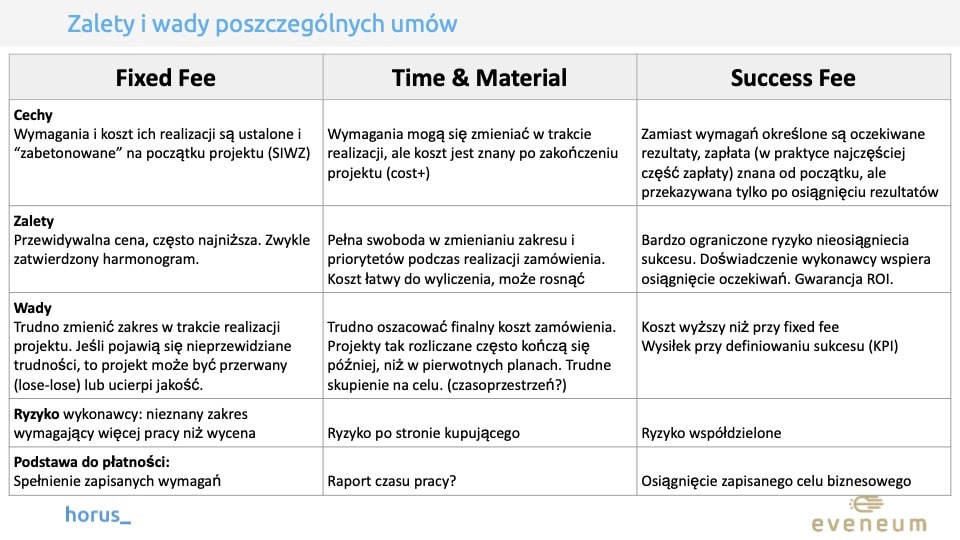
In the case of a Fixed Fee contract, we agree on a specific thing for a specific money, delivered over a specific period of time. The client should provide a well-prepared order specification (detailed scope). Konrad Krochmal pointed out that this is often the preferred solution from the point of view of the CFO (chief financial officer) and management. Management knows in advance how much they will pay and when they will see the results of the work. When the ordering party learns something new during the course of the project or their needs change, friction begins to arise between supplier and client. The supplier in this type of project assumes all the risk. Depending on the level of trust in the client, it can „insure” itself by increasing its price (margin) in the event of problems arising from poor client specification and knowledge.
Does the Fixed Fee model lead to successful procurement of IT services?
According to. Piotr Machowski no. In the Fixed Fee model, the specification dictates the requirements that the purchased product has to meet. If it meets them, it is received and the project is completed. But did, for example, the new CRM actually increase the sales of the client company?
In the Time & Material model, the customer pays for the supplier's time. As in the Fixed Fee model, requirements and specifications can change over time. Most often, the total cost of a project is not known to the client until the project is completed. Projects based on Time & Material principles very often end up later than originally planned because the supplier is not particularly motivated to „push” deadlines, he added. Piotr Machowski. The design risk is entirely with the purchaser. The supplier will carry out the purchaser's instructions by accruing working hours. The implementation of an ERP system based on the Time & Material method was given as an example. The actual implementation time turned out to be several times greater than the IT department's initial scenario.
Konrad Krochmal juxtaposing the Fixed Fee and Time&Material models, he stressed that the latter is strongly preferred by in-house stakeholders. The client needs to be aware of the supplier's skills and pay for work that delivers value. The client's stakeholders on the fact that they can influence changes during the project and the final solution will ideally meet the users' needs.
„The stakeholder has false hopes that maybe we'll pay a little bit more, but maybe we can get something more done with it.” ~Conrad Krochmal
One participant at the meeting described this as „extra features, because after all it's only a few more hours of work”. Tomasz Bykowski from his perspective, summed up the two models in the following way:
- Fixed Fee, when predictability and cost are important
- Time & Material when you want a high-quality solution
Success Fee model - as a wizard of success in IT service procurement
The participants spent most of their time discussing a modern model based on Success Fee. In this model, all members of the project team focus on the outcome. The goal is not to meet the requirements of the specification, but the business success of the customer, e.g. „the goal of the ERP implementation is to make the production process more efficient by 4% or more precisely to beat costs in a specific part of the production process by X%”. In a result contract, part of the payment to the supplier is conditional on achieving this goal. This is a kind of bonus for high quality work and cooperation.
„The biggest benefit for both parties is the clarity of why we are doing the project and what we are aiming for.” ~Tomasz Bykowski
As he stated Piotr Machowski Often the name of the project itself can be misleading. Often when opening a specification from a client that is 100+ pages long, suppliers see a title such as „Implementation and configuration of a purchasing platform at XYZ company”. You may ask yourself why are we implementing this platform? What is to be successful? Are we to tell the customer? Is he to tell us what will be a business success for him?
How do we measure this success and account for it on that basis?
For example, let's define the success of a project as „Achieve readiness to sell through the digital channel no later than 1 May”. The IT service provider's task, in this larger business project, will be to deliver a system to support these sales. In a project like this, there are many risks that fall on both the client and the supplier. You can always push each other's responsibility if something bad happens. Or you can work together to, even at extra cost, overcome unexpected difficulties.
How do you keep the supplier motivated for such interaction?
An agreement can be made with the supplier that when the defined project success is achieved, a bonus of, for example, 20% of the contract value will be paid to the supplier. Defined success, is a great tool to mobilise the client and supplier team to work together. The most important thing in this type of collaboration is that success must be defined by the client and be clear to the supplier. The supplier may ask questions, want to understand very well, which can be annoying for the client's project team. But it is only by having a good understanding of the success criteria and measuring it that success can be achieved with this type of project - the Tomasz Bykowski
Tomasz Bykowski gave examples of clauses from project and framework success agreements that he had the pleasure of executing with clients, where the success bonus ranged from 1% to several per cent. The potential bonus always provokes discussions that would not normally take place:
- As a supplier, I need to know from the outset what success means to you and how you measure it (we avoid a situation where the customer says they are dissatisfied and the supplier doesn't understand why)
- Secondly, success will need to be discussed during the course of the project, often, this builds rapport and helps minimise the risk of failure, there is no work for work (art for art's sake)
- If there are problems in achieving success, the supplier will signal this right away. He won't sit quietly by because his scope will still increase, with no increase in remuneration....
Konrad Krochmal He added that this has a huge impact on project management itself. He pointed out from the client's point of view, the key is how we should define success. This requires purchasing to have a very good understanding of their organisation, but also why this project is being purchased and how it will change the company. Only by understanding the wider context are we able to define success and the KPI's by which we will measure it.
Is it easy to define success criteria and its measures?
This question sparked a very interesting discussion between the Piotr Machowski a Konrad Krochmal. Peter stated that this should probably not be a rather difficult discussion in a customer organisation. Konrad argued that purchases often have to buy something that they don't fully understand. That is, they understand the product itself, such as a data centre. Unfortunately, 50% buyers will not be able to say why the company is changing the data centre, or what such a change will do for the company. Peter stressed that this is a critical question, what is important to you dear internal partner!
Tomasz Bykowski noted that procurement does not usually have the time to be continuously present on a project. He suggested demanding that the business identify one critical KPI that, when monitored systematically, would tell us that we were moving towards success. He gave the example of a multi-million pound contract executed by his team, with the key KPI being: „Cost reduction of X PLN in one customer segment as a result of using Y technology to serve that customer”. Of the many KPIs, this one was considered key because if it was not achieved then:
- Call centres will not want to work on customers
- Customers will not want to use the new form of service
- Generally... it all doesn't work....
Training for call centre staff was not included as part of the contract he referred to. The project team and the supplier recognised that buy-in callc enter was key to achieving the indicator defining success. The scope of the project for the supplier was therefore extended. It organised the first call centre training in the use of the new solution.
Success can also be contained in framework contracts. Tomasz gave the example of a contract with a foreign client:
„Ideas that has direct improved revenue and has contributed to cost effectiveness of customer shall be financially rewarded”. ~Tomasz Bykowski
What barriers will we face when introducing the philosophy of outcome contracts (success fees) in our organisation?
Another item on the agenda was a discussion about the barriers limiting the wider use of contracts based on a success bonus. Specifically about who is opposing this type of solution in client organisations. Piotr Machowski stated that he signed his first success fee-based contract in 2008. It was an innovative solution for the time: „Artificial intelligence in customer complaints management”. Writing a good specification for what we buy and what we receive for artificial intelligence in 2008 was difficult. Describing the story, he said that he communicated quickly with the client's technical side. They agreed that they would focus on the outcome, not the scope.
The biggest barrier at the time was the supplier's legal advisors. It was a big challenge for the supplier's legal department to move from a contract of workmanship, to a contract of results, in order to reduce the time for handling complaints. The supplier's CEO was able to agree to a results contract, but the lawyers saw too many risks in this form. Convincing the lawyers was a major challenge for everyone.
Konrad Krochmal emphasised that the client's organisational culture can be an opponent of outcome-based contracts. Companies that have been on the market for a long time, are mature and have their own way of operating will be less inclined to sign success fee contracts (result-based contracts). They treat the budget as an „institution”. The CFO is very often a deal-breaker if he or she feels they do not have a predetermined budget and control over it.
Peter stressed: „Don't enter into a success contract if the company that wants to order something doesn't know what its success is!” If there is no clarity, no agreement, no consensus between the client's managers who want to buy something, then there is no space for a contract based on success (outcome).
Piotr Machowski encouraged the client's purchases to take a long requirements specification of several dozen pages and look at the header. More often than not, it says „The aim of the project is to implement a system (and here the name of the system)”. The supplier sees no problem in implementing the system. Tomasz Bykowski recommends that buyers reject such headlines. They should include a definition by the project team of „what will make you happy when we meet e.g. in a year's time”, how will you evaluate success after implementation and start of use?
For example, ask the business directly „listen, if we meet next year then...”. e.g:
- Finance: how we can better anticipate liquidity!
- Sales :as we sell more by 10 %!
If suppliers, when hearing such targets, run away screaming, then perhaps your assumptions are completely unrealistic and you need to rethink the business case. Talking to suppliers is a good time to check our success criteria.












 Polish
  English