





What is allocation?
Allocation is when the supply chain faces a sudden disruption that affects supply on an unprecedented scale. Suddenly, many manufacturing companies are left without enough materials, raw materials, components. Such companies cannot continue production or deliver the quantity required by their final customers. Buyers begin to compete for scarce materials to ensure adequate quantities for themselves at the expense of others. There are gambling plays, the whiplash effect and the famous prisoner's dilemma: to cooperate or not?
An example of gambling during the allocation period from the life of an ordinary Smith.
Smith is a fan of Sony's PlayStation consoles. As of December 2020, the latest version of the console, the PlayStation 5 model, is being launched. Sony, due to component supply shortages, is unable to deliver enough units to the market. What the company “throws” on the market is bought up on the stump. What we are observing in the market:
- individual customers are waiting on the websites of online shops to buy their dream console, but the shop announces a shortage of stock 30 seconds after the item appears
- dedicated shopping bots, faster than the human hand and eye, they buy up 6-7 copies each so that their owner can resell them at a profit
- appear organised groups of fence-sitters, betting on a few shops, making purchases where they can be quicker, and then reselling the consoles at a profit on auction sites
The result?
Prices on Allegro or Amazon at 4,000PLN, 6,000PLN and more per console when Sony's official prices are 2299PLN. And so there will be needy people who will overpay but buy because they really, really need to have a Playstation 5 console right now.
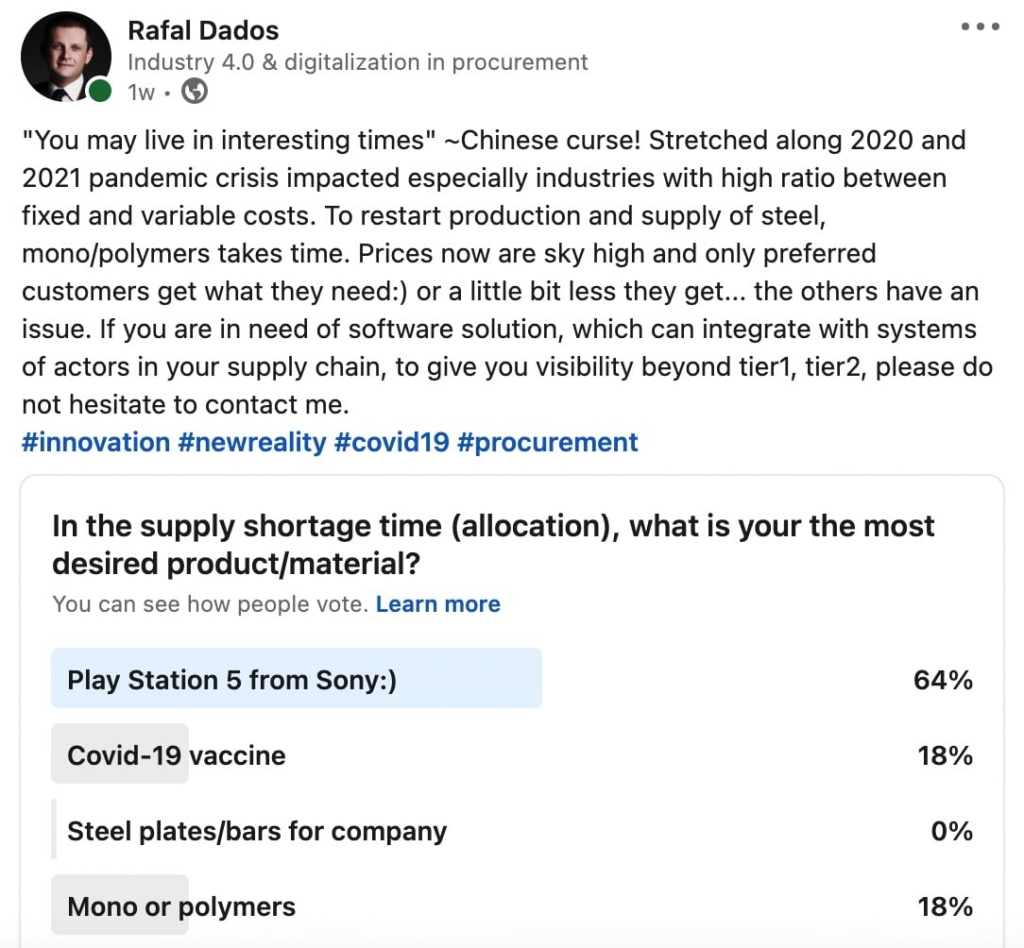
Below is the result of a survey I conducted on LinkedIn.
Can such a situation occur in business-to-business relations?
Allocation. Examples of such situations from the past:
2008-2009. economic crisis is a crisis in the supply chain. Allocation in the electronic components market.
Governments around the world are embarking on a subsidy programme to revitalise the automotive sector. Their intention was to increase demand for small cars through financial incentives for end customers. As a result, demand for small cars increased dramatically, forcing entire supply chains to supply and manufacture according to the technical design of such cars. Suppliers of electronics (relays, capacitors, fuses, etc.) were unable to meet the demand. Tier 1 and OEMs began to compete for scarce resources. Many customers began to artificially raise forecasts, buying „on stock/stock”. The schedule characteristic of automotive exploded throughout the supply chain, emotions began to take over. Suppliers had to decide which customer to serve and which demand to leave unsatisfied.
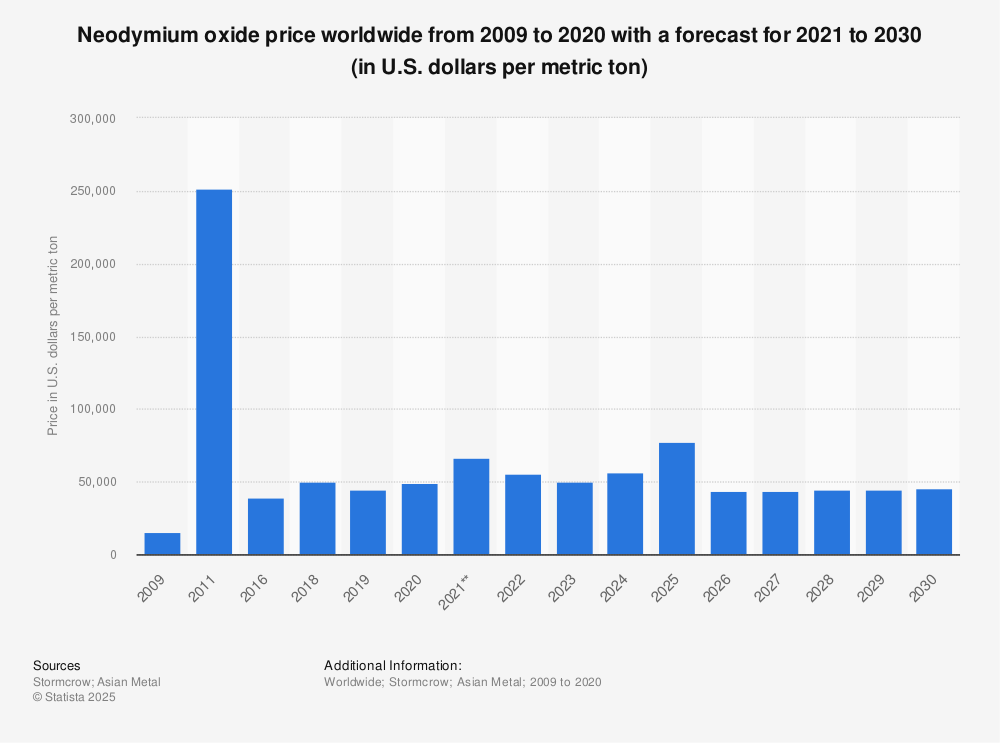
2010. political crisis causes supply chain crisis. Rare earth minerals. Chinese export quota reduced by 40%.
China controlled 97% the supply chain of rare earth mineral extraction and production. The world was completely dependent on Chinese raw material suppliers. In 2010, China decided to radically change the rules in the value stream. Previously imposed export quotas for rare earths were further reduced by 40%. The impact on the price of neodymium (one of the rare earth elements) is shown in the chart below:
Source: Statista
The Chinese government's aim was to force, among other things, foreign permanent magnet manufacturers to relocate production to China or to force foreign companies to buy finished permanent magnets from Chinese manufacturers. They wanted to improve the Chinese position in the entire value chain. For several years, the whole world was forced to buy from China.
Imagine a model company in Europe that had no experience in purchasing from outside the European Union, that did not have the right purchasing skills. Not a very pleasant situation for managers....
2018 Allocation and the climate crisis. Low river water levels in Germany.
Germany has a well-developed inland river transport system. Due to climate change, Europe is increasingly exposed to floods and droughts. In 2018, one large resin producer was immobilised due to low water levels in the river, a ship with oil-based raw material could not arrive for several weeks. The supply of such raw materials on the market has consolidated significantly in recent years. A small number of producers control the market and, in addition, due to capital-intensive processes, often produce from a single location, exporting all over the world.
A buyer who buys plastic or foam functional items from his level may not even be aware of such a situation at the -2 or -3 value chain level, unless he is equipped with good tools and monitors the media and social networks. Ultimately, the supplier in a critical period of shortage (often force majeure) has to decide which customer to serve and which demand to leave unsatisfied.
Past articles on the problem in BASF i Thyssenkrupp.
2020-2021 Health and work crisis. Coronavirus (#covid19) brings the world to a halt.
In many countries, the lockdown is causing a change in customer habits. The inability to go on holiday or use services is driving demand for games consoles, phones and consumer electronics in general. With the legislative change in the European Union, car manufacturers need to produce a sufficient number of electric and hybrid cars to ensure that their product range meets the legal requirements in the market. Allocation at the end of 2020 in the markets for e.g. steel, mono and polymers has become a reality. It causes trouble a level higher up, i.e. in the sector of suppliers of metal, electronic or plastic components.
We see in the automotive, aerospace, medical and electronics sectors how supply chains are being torn apart and how the principle of interconnected vessels is at work. One after another, global brands are announcing production stoppages due to component shortages or delayed deliveries.
Which can help mitigate risk when allocation hits you:
- a well-conducted market and risk analysis in the purchasing category management process. communicating with the supplier the vision and future of the business beyond MRP and S&OP
- close cooperation with delivery and transparent rolling forecasts from logistics
- two or even three times more frequent communication with the supplier than usual
making sure you are the preferred customer. The carrot and stick method in an allocation situation does not work! If you are not a preferred customer, even if you stand on your proverbial eyelashes, it won't do you any good - established process for measuring supplier performance as part of the SRM process
- digitalisation and a modern approach to the procurement process
- look for non-competing companies in your area that also need the raw material in question. Together you can move up the hierarchy of importance from the local distributor level, to the regional level and maybe even to direct service by the manufacturer.
- look for different markets than usual, in different regions. Use subsidiaries to source materials









 Polish
  English